

 Home
Home About Us
 Careers
 Mobile Apps
 Web Apps
 Blockchain
 Digital Marketing
 Enterprise Solutions
 Others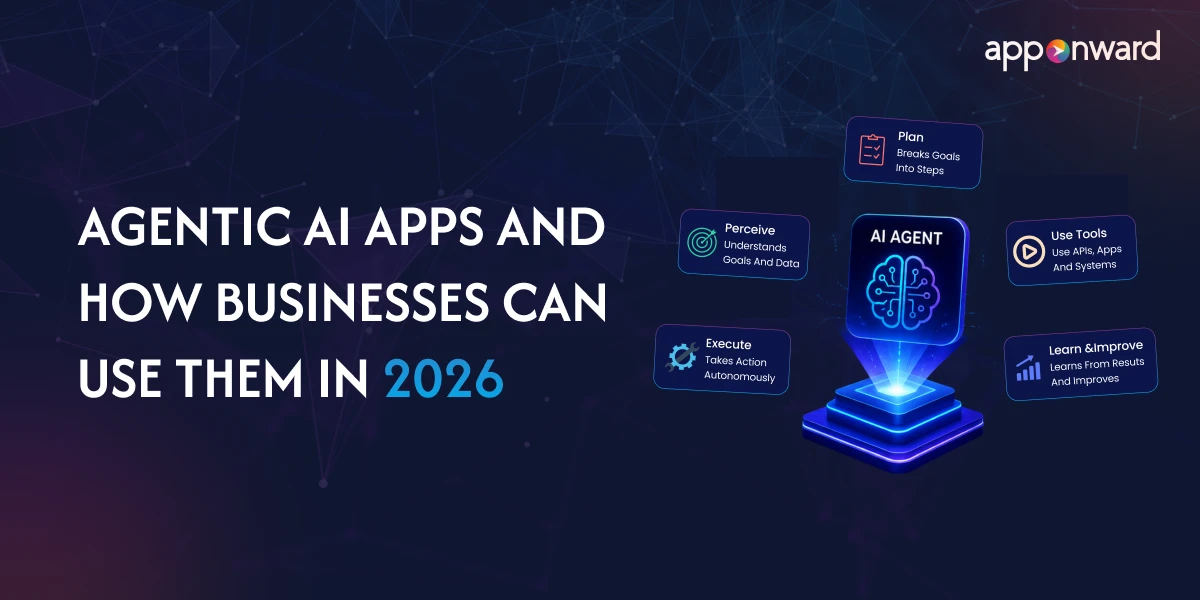
 16/06/2026
Anand Kumar Mishra
18 Mins to Read
Table of content
Agentic AI Apps: What They Are and How Businesses Can Use Them in 2026
Agentic AI apps are software applications that can plan, reason and act on their own to complete multi-step tasks without constant input. Unlike regular AI tools that wait to be asked, they take initiative. In 2026 they are already transforming how businesses automate operations, serve customers and make decisions.
Key Takeaways
-
- Agentic AI apps go beyond chatbots. They perceive goals, plan actions, use tools and execute tasks.
- The global agentic AI market is projected to hit $10.8 billion in 2026, growing at a 43.8% CAGR through 2034.
- Gartner predicts 40% of enterprise applications will include task-specific AI agents by end of 2026.
- Real-world use is already happening. Salesforce Agentforce, Microsoft Copilot Studio and IBM watsonx are in production today.
- Businesses not yet experimenting with agentic AI risk falling behind a fast-moving adoption curve.
- Building one does not require a team of 50 engineers. The right platform and the right partner make it accessible.
What Are Agentic AI Apps ?
Agentic AI apps are autonomous software systems that use LLMs to set goals, plan multi-step actions, select tools, execute tasks and learn from outcomes, all with minimal human interference.
The clearest way to understand them is by contrast. A traditional AI tool answers a question when you ask it. Agentic AI apps go further. You give them a goal. They figure out the steps, run those steps across multiple tools and systems, check their own results and course-correct if something goes wrong.
According to IBM’s 2026 Guide to AI Agents, an AI agent is “a system capable of autonomously performing tasks by designing its own workflow and utilizing available tools.” That autonomy is the defining characteristic.
How Big Is the Agentic AI Market in 2026?

According to IDC data published in April 2026, the agentic AI market expanded from $7.6 billion in 2025 to a projected $10.8 billion in 2026. Mordor Intelligence puts the long-range figure at $57.42 billion by 2031, growing at a 42.14% CAGR. IDC further projects total AI spending will reach $1.3 trillion by 2029, with agentic AI applications as the primary driver.
The adoption data is equally striking. According to a 2026 MuleSoft and Deloitte Digital survey, 93% of IT leaders plan to introduce autonomous agents within two years and nearly half have already started. PwC’s May 2026 survey of 300 senior executives found that 88% plan to increase AI-related budgets specifically because of agentic AI. And Gartner named agentic AI one of the top 10 strategic technology trends for 2025, predicting it will drive roughly 30% of enterprise application software revenue by 2035.
How Can Self-Governing AI Tools Benefit My Business Operations?
Self-governing AI tools reduce operational costs, speed up repetitive processes and free staff for higher-value work. They handle tasks like invoice processing, lead qualification and support triage around the clock without fatigue or error, delivering measurable ROI across industries from finance and healthcare to retail and real estate.
Here is a straightforward breakdown of where agentic AI apps deliver the most measurable value:
Operational cost reduction – Agents handle repetitive decision-making without staffing costs. A single AI agent can process invoices, triage support tickets, or qualify leads around the clock.
Speed at scale – Research from Statista shows agentic tools can complete research and planning tasks in 9.2 minutes versus 38.5 minutes manually. That is a 76% time saving on knowledge work.
Consistent execution – Humans make errors when fatigued. Agents do not. For regulated industries like finance and healthcare, consistency in process execution is valuable beyond simple efficiency.
Lower barrier to automation – Platforms like Salesforce Agentforce and Microsoft Copilot Studio now allow non-technical teams to deploy agents without writing custom code. This is the accessibility shift that is accelerating SMB adoption in 2026.
According to a Market.us report, 83% of executives now view agentic AI investment as essential to staying competitive. That number was less than 30% two years ago.
How Do Agentic AI Apps Improve Business Workflows?
Agentic AI apps eliminate the manual handoffs that slow most business workflows down. They receive a goal, break it into steps, select the right tools, execute each step autonomously and self-correct when outputs fall short, replacing coordination overhead with a consistent, monitored execution loop that runs without human intervention.
Here is how the agent execution loop works in practice:
-
- Goal Input – A human or system defines the desired outcome.
- Planning – The agent breaks the goal into discrete steps.
- Tool Selection – The agent identifies which APIs, databases, or services it needs.
- Execution – It runs each step autonomously, in sequence.
- Monitoring – It checks its own outputs against expected results.
- Adjustment – It self-corrects or escalates to a human when something is off.
This loop replaces manual coordination, reduces context-switching and lets your team focus on work that genuinely requires human judgment.
For mobile-forward businesses building customer-facing products, working with a top app development companies that understands agentic architecture from day one avoids costly retrofitting later.
What Are Examples of Autonomous AI Software?
Autonomous AI software already in production includes Salesforce Agentforce, Microsoft Copilot Studio, IBM watsonx Orchestrate, Google Antigravity and Lindy AI. These are not prototypes; they are handling sales, HR, customer service and banking workflows at scale across thousands of organisations globally right now.
Salesforce Agentforce – Autonomous sales and service agents that handle lead qualification, follow-ups and case resolution without human handoffs. Used by enterprises including Wiley and OpenTable.
Microsoft Copilot Studio – Allows businesses to build custom agents that work across Teams, Outlook and third-party tools. Deployed by over 230,000 organisations globally as of early 2026.
IBM watsonx Orchestrate – Enterprise-grade agent builder for HR, procurement and customer service workflows. Used by companies like Comparus for AI-powered banking assistance.
Google Antigravity – Launched at Google I/O in May 2026, it is Google’s agent-first developer platform for building and deploying autonomous agents across applications.
Lindy AI – A no-code ai agent app builder that lets teams create agents to research prospects, extract listing data, send personalised follow-ups and manage CRM entries automatically.
These are not demos or prototypes. They are running in production, at scale, in 2026.
What Are the Top Agentic AI Apps Available for Personal Productivity?
The top personal productivity agentic AI apps in 2026 include Claude, ChatGPT Agent, Perplexity Computer, Gumloop and n8n. Each offers varying levels of autonomy for tasks like research, writing, web browsing and workflow automation allowing individual professionals to reclaim several hours of manual work every week.
Top personal productivity tools with agentic capability in 2026:
-
- Claude (Anthropic) – Research, writing, analysis and task automation with memory and extended reasoning.
- ChatGPT Agent (OpenAI) – Autonomous web browsing, file handling and code execution within a single interface.
- Perplexity Computer – Multi-model orchestration for research and synthesis tasks.
- Gumloop – No-code workflow builder that connects agents to your existing tools without engineering help.
- n8n – Open-source automation platform with growing agentic workflow capabilities.
For teams building agentic AI apps for Android, native integration is critical. Android application development solutions that account for agent SDKs and background task permissions from the start will save significant rework later.
AI Apps for Real Estate Agents: A Real-World Use Case

AI apps are saving real estate agents 12 to 16 hours per week by automating lead research, MLS data extraction, listing content creation and around-the-clock inquiry handling. With 97% of brokerage leaders reporting active AI use, real estate is one of the clearest early adopters of agentic technology across any industry.
According to a January 2026 Delta Media survey covered by Inman, 97% of brokerage leaders report their agents are now actively using AI. A JLL Research 2025 survey found that 89% of C-suite leaders in commercial real estate believe AI can help solve their biggest operational challenges.
What ai apps for real estate agents are actually doing:
-
- Researching prospects on LinkedIn and extracting property details from MLS listings automatically.
- Generating listing descriptions, social posts and email campaigns in under a minute.
- Running predictive analytics to identify high-probability sellers before they list.
- Handling incoming lead inquiries around the clock without agent involvement.
Ascendix Technologies reports that AI CRM agents are saving real estate professionals 12 to 16 hours per week. For a solo agent or a small brokerage, that is a transformational shift in how time gets spent.
Easiest Way to Integrate AI Agents into B2B SaaS Apps
The easiest way to integrate AI agents into B2B SaaS apps is to start with one high-friction workflow, choose a proven framework like LangChain or CrewAI, deploy a single-task agent first and add human oversight checkpoints before expanding. Proving value on a narrow use case prevents the governance failures that kill most early projects.
A practical 4-step framework:
-
- Map your highest-friction workflow – Find the process where humans spend the most time on repetitive decision-making.
- Choose the right agent framework – LangChain, CrewAI and Microsoft AutoGen are the most production-tested. Match the framework to your existing stack.
- Start with a single-task agent – A focused agent that does one thing well delivers ROI faster and fails more safely than a multi-agent orchestration system.
- Add human-in-the-loop checkpoints – Especially in the early stages. This controls risk and builds team trust in the system before you expand autonomy.
Gartner warns that over 40% of agentic AI projects will be cancelled by end of 2027 due to poor governance, unclear ROI and escalating costs. Starting narrow and proving value first is the only reliable path.
Cross-platform frameworks are a smart starting point for mobile integration. Flutter application development services allow agent-powered features to deploy consistently across iOS and Android from a single codebase. Equally, react native application development services offer strong flexibility for teams already working in JavaScript-based environments. For premium iOS experiences where performance is the priority, ios mobile app development gives you the native access that agentic features often require.
How to Build Agentic AI Apps: Comparison of Top Platforms
| Platform | Best For | Technical Skill Needed | Starting Cost |
| Microsoft Copilot Studio | Enterprise SaaS integration | Low (no-code) | From $200/month |
| Salesforce Agentforce | CRM and sales automation | Low to Medium | Part of Salesforce plans |
| LangChain + LangGraph | Custom agent development | High (developer) | Open source |
| Lindy AI | SMB and solo workflows | Very Low (no-code) | From $49/month |
| IBM watsonx Orchestrate | Regulated enterprise use | Medium | Enterprise pricing |
| Gumloop | Non-technical teams | Very Low (no-code) | Free tier available |
Common Mistakes Businesses Make With Agentic AI Apps

The most common mistakes businesses make with agentic AI are starting too broad, skipping governance frameworks, failing to connect agents to real data and measuring outputs instead of business outcomes. Deploying without human-in-the-loop controls is especially dangerous in regulated industries and remains the leading cause of early project failure.
-
- Starting too broad – Multi-agent systems sound exciting but fail more often than single-task agents, especially in early deployments.
- Skipping governance – Only 21% of companies are projected to have mature AI governance frameworks by 2028. Building agents without oversight controls is a liability.
- Ignoring integration depth – An agent that cannot access your real data cannot do anything useful. Data connectivity is the foundation.
- Measuring the wrong things – Tracking tasks completed instead of business outcomes (time saved, revenue generated, error rates reduced) makes it impossible to assess real ROI.
- Deploying without human-in-the-loop controls – Especially in regulated industries, autonomous action without oversight creates compliance risk.
Best Practices for Building and Deploying Agentic AI Apps
The best practices for deploying agentic AI apps are to define one clear measurable goal, use established frameworks like LangChain or CrewAI, set escalation paths to humans, build audit logs from day one and test on synthetic data before going live. Revisit and retrain agents quarterly as your business processes evolve.
-
- Define a single, measurable goal before writing any code or configuring any platform.
- Use pre-built frameworks like LangChain, CrewAI, or AutoGen rather than building from scratch.
- Set clear escalation paths so agents know when to hand off to a human.
- Build audit logs from day one so every agent action is traceable.
- Test with synthetic data before connecting agents to live production systems.
- Revisit and retrain agents quarterly as business processes evolve.
Conclusion
Agentic AI apps are not a future technology. They are a 2026 reality, already running inside the world’s largest companies and increasingly accessible to small and mid-sized businesses through no-code platforms.
The market is moving at 43.8% CAGR. Adoption among Fortune 500 companies hit 67% in 2025. Gartner says 40% of enterprise applications will embed AI agents by year end. The question for most businesses is not whether to engage with agentic AI. It is whether to start now with a focused, governed approach or wait and close a widening competitive gap later.
Start with one workflow. Pick a framework that fits your team. Prove value before you expand. That is how the businesses winning with agentic AI apps in 2026 are actually doing it.
FAQs
What are agentic AI apps?
Autonomous software systems that plan, reason and execute multi-step tasks independently to achieve a defined business goal.
How do agentic AI apps differ from regular AI tools?
Regular AI tools respond to prompts. Agentic AI apps initiate action, plan steps, use tools and self-correct without constant human input.
What are the best agentic AI apps examples in 2026?
Salesforce Agentforce, Microsoft Copilot Studio, IBM watsonx Orchestrate, Google Antigravity and Lindy AI are among the most widely deployed.
How do I build agentic AI apps for my business?
Start with a single high-friction workflow, choose a framework like LangChain or CrewAI, build a focused single-task agent and add human checkpoints before expanding.
Are there agentic AI apps for Android specifically?
Yes, agent capabilities can be embedded into Android apps using native SDKs and cross-platform tools. Proper architecture planning is key from the start.
What is an ai agent app builder?
A platform that lets you create and deploy autonomous AI agents, either through no-code interfaces like Gumloop and Lindy or developer frameworks like LangChain and AutoGen.
What are the top agentic AI apps available for personal productivity?
Claude, ChatGPT Agent, Gumloop, Perplexity Computer and n8n are the most widely used personal productivity agents in 2026.
What is the easiest way to integrate AI agents into B2B SaaS apps?
Map your highest-friction workflow, choose a compatible framework, build a single-task agent first and prove ROI before scaling to multi-agent systems.
How are ai apps for real estate agents being used today?
For automated lead follow-up, MLS data extraction, listing content generation and predictive analytics, saving agents up to 16 hours per week.
What is an ai agent for mobile apps?
An autonomous AI system embedded in a mobile application that can perform tasks like scheduling, research, notifications and CRM updates independently on behalf of the user.
What is an AI agent for mobile apps?
An AI agent for mobile apps is an autonomous, intelligent assistant embedded within a mobile application that can perform tasks independently on behalf of the user, without requiring constant manual input.
Unlike standard automation, AI agents:
Understand context and user intent
Make decisions based on patterns and preferences
Execute multi-step tasks automatically
Learn and adapt from user behavior over time